TRADITIONAL
CHINESE ENERGETICS
The study of the relationship between
SKY - HUMAN - EARTH
WHAT IS TRADITIONAL CHINESE ENERGETICS ?
SAN CAI

In Traditional Chinese Energetics (TCE), the human being (Rén 人) exists between Heaven (Tiān 天) and Earth (Dì 地). Rén 人- the human - is continuously influenced by both the descending movements of Heaven and the ascending movements of Earth. This relationship is traditionally expressed as the principle of the Three Powers : Sān Cái 三才
Within this traditional perspective, health depends on the body’s ability to receive, interpret, transform, and respond to these different energetic influences.
The movements of the seasons, climate, and natural cycles influence the growth and transformation of life on Earth. Through food arising from the Earth and shaped by the rhythms of Heaven, the human body receives nourishment that must be absorbed, transformed, and distributed into the various energies and fluids needed to sustain, protect, and regulate the organism.


Sky
SAN BAO


Human


Earth
The principle of the thee treasures (Sān Bǎo 三寶)can be represented through the metaphor of an oil lamp:
Jīng 精 is the nourishing oil, Qì 氣 the transforming flame, and Shén 神 the light that shines from it. Just as a lamp requires all three to fulfill its purpose, these aspects of the human being exist in continual relationship and mutual support.
Within this continual relationship, the human body must remain capable of sensing and adapting to its environment; Temperature, humidity, wind, activity, rest, rhythm, emotions, and the various external influencing factors. The human body needs to continuously adjust its internal balance, nourishment, and defensive mechanisms according to the environment around it.
The continuous process of dynamic balance is also understood as a continuous process of cultivation and harmonization of the Three Treasures


Essence
Oil

_edited.png)
Energy
Flame

_edited.png)
Awareness
Light

CLASSICAL FRAMEWORKS


The Laws of
Yin Yang


The five
Movements


The Twelve
Channels


The Eight Extraordinary Vessels


The Tripple Bruner

THE FUNDAMENTAL WAYS
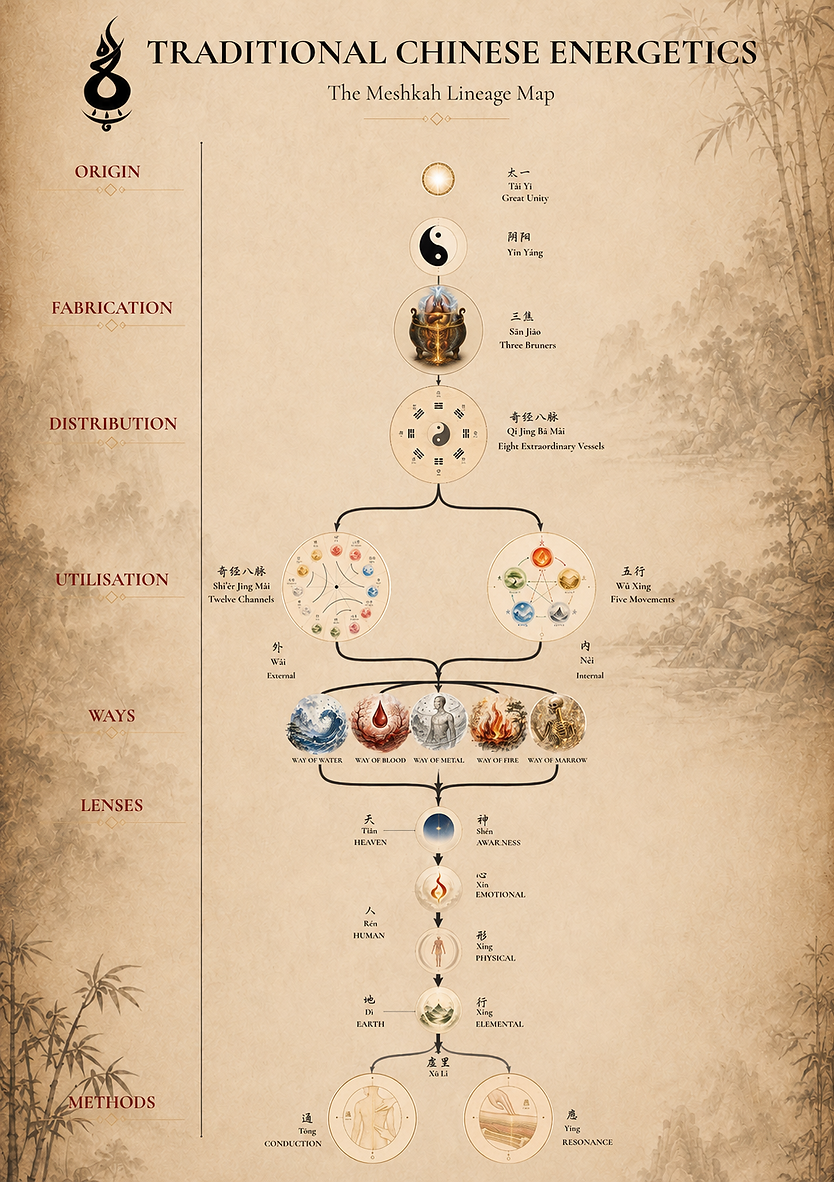
The theoretical foundations of Traditional Chinese Energetics within the Meshkah curriculum, are explored through a series of major pathways known as the Ways. The student progressively discovers the principles, the dynamics, and the therapeutic applications of Traditional Chinese Energetics.

Way of Water
.jpeg)
Way of Blood
.jpeg)
Way of Metal
.jpeg)
Way of Fire
.jpeg)
Way of Marrow
THERAPEUTIC LENSES
The traditional Chinese energetics therapeutic method is based upon four lenses that provide principles and practical techniques to understand, analyze and diagnose the human body holistically based on the relation of the Human between Heaven and Earth

Elemental
The elemental lens is premised on the principles of the five movements/ elements.This involves seasonal rhythms, enviromental influences, the corelation between the organs of the body and the five movements, the study of the five shu transporting cavities (Wǔ Shū Xué 五輸穴) of each organ and much more. This lense teaches the student to examine the relationship between the individual and their environment. It also allows the student to learn to observe how the human being interacts with the natural world. The study of the five shu points principle in particular is essential for this lens. Then five shu transporting cavities are areas through which the body receives and responds to information from its environment. When this relationship becomes weakened, the individual$s ability to adapt harmoniously to the influences of Heaven(Tiān 天) and Earth (Dì 地) may also become impaired.


Physical
The physical lense is concerned by the body’s functional dynamics. Through this lense focus particularly the nourishment, circulation, and the regulation associated with the twelve primary organs and viscera systems described by Traditional Chinese Energetics. Students learn to observe patterns of excess, deficiency, stagnation, and imbalance within these functional systems. This lens is explored through the study and use of the Back Shu Points (Bèi Shū Xué 背俞穴), Front Mu Points (Mù Xué 募穴), Channel Divergences (Jīng Bié 經別), and Source Points (Yuán Xué 原穴), which are traditionally used to influence and regulate the physiological functions of the body. The purpose of this lens is to understand the harmonious functioning of the organ and viscera systems in order to maintain health and vitality.
_edited.png)

Emotional
In Traditional Chinese Energetics, emotions are considered one of the major causes of disease when they become excessive, prolonged, unresolved, or repeatedly suppressed. Such states may affect the circulation of Qi and contribute to physical and psychological imbalance. The perspective of the emotional lense gives a way to understand how emotional experiences leave traces within the body. The study of the "Emotional Chains" teaches the students to learn to identify, regulate, and release patterns that link emotions to tissues and influence the circulation of Qi. The purpose of this lens is to restore movement where emotional patterns have become fixed and to support greater harmony between body, emotions, and mind.
_edited.png)

Awareness
This lens explores the different functions of awareness and consciousness described within Traditional Chinese Energetics. This specific are of awareness and consciousness has an influence on perception, behavior, emotional life, and physical well-being. Through the study of concepts such as Shén 神 (awareness), Hún 魂 (imagination, dreaming, and envisioning), Pò 魄 (instinct and embodied memory), Zhì 志 (will), and Yì 意 (the conscious organizing function), students are introduced to traditional models describing the different functions that participate in human consciousness and their influence on the body-mind relationship. The purpose of this lens is not only to relieve symptoms, but also to cultivate greater coherence between body, emotions, mind, and awareness .
_edited.png)

MANUAL METHODS
The practical transmission taught at Meshkah is primarily based on the method of manual resonance of the S.F.E.R.E. College lineage. The teachings or theses methods is supervised in Egypt by Mr. Régis Blin (Co-Director of S.F.E.R.E.)
These methods are aimed at accompanying and influencing the circulation of Qi through the channels (Jīngmài 經脉) and energetic cavities (Xuéwèi 穴位), while encouraging the body’s own capacity for regulation, adaptation, and balance.


Conduction Techniques
Conduction techniques focus on restoring continuity and circulation through the channels and tissues. The student learns manual methods that particularly focus on the Jīng Jīn 經筋 (Sinew Channels), Zhèng Jīng 整經 (Primary Channels). Those manual methods give Particular attention to the regulation of Wèi Qì 衛氣 (Defensive Qi) and the nourishment of Yíng Qì 營氣 (Nutritive Qi).

Resonance Techniques
Resonance techniques focus on the energetic relationships expressed through the Five Movements (Wǔ Xíng 五行) and the Five Shu Transportation Cavities (Wǔ Shū Xué 五輸穴) of the Twelve Primary Channels.
_edited.png)
TRADITIONAL CHINESE THERAPY


Acupuncture
The use of needling techniques on specific points and channels of the body in order to regulate the circulation of Qi.


Chinese Herbalism
The use of a wide variety of traditional herbal formulas for both internal and external applications. These formulas are traditionally classified according to their energetic nature, flavor, temperature, and function. They are prescribed also in accordance to the conditions and the constitution of the individual.
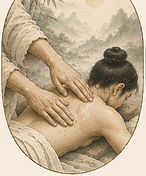

Tui Na
Tui Na is a traditional Chinese manual therapy and massage system based on acupressure, mobilization, manipulation, and channel-based techniques. It is used to influence the circulation of Qi and Blood, release tension, support structural balance, and assist the body’s natural regulatory functions.
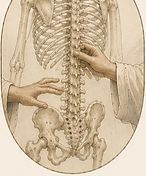

Zheng Gu
Zheng Gu, literally meaning “Correcting the Bones,” is a traditional Chinese manual therapy system historically associated with martial arts medicine and trauma treatment


Qigong
Literally means “work with Qi” or “cultivation of energy,” Qigong includes physical, respiratory, postural, and meditative exercises traditionally used to maintain health, regulate the body and mind, and cultivate internal awareness.
Beyond personal cultivation practices, Qigong has also traditionally been used as a therapeutic approach to support health, regulate the circulation of Qi, and accompany the healing process. In this context, Qigong may be applied not only as an individual practice, but also as a healing modality used by practitioners working directly with patients.

MESHKAH TCE LINEAGE MAP